Basic and advanced oculoplastics wet-lab
This brand new course will provide structured, supervised hands-on practice in periocular repair and reconstruction on porcine specimens, for ophthalmology trainees.
You'll work through nine procedures, from basic procedures to more advanced including: eyelid laceration repair and tarsorrhaphy to skin grafts, Hughes flaps, periocular local flaps and evisceration.
Learning outcomes
- Select and handle oculoplastic instruments, sutures and needles appropriately, and describe safe local anaesthetic use in the periocular region.
- Describe the lamellar anatomy of the eyelid and apply it to the assessment and repair of full-thickness and marginal defects.
- Apply the principles of flap construction to periocular defects of varying size and site.
- Perform, under supervision, temporary and permanent tarsorrhaphy, eyelid laceration repair, wedge excision and direct closure.
- Perform, under supervision, upper lid blepharoplasty with full-thickness skin grafting, a Hughes tarsoconjunctival flap, bilobed and rhomboid periocular flaps, and evisceration.
Course structure
Attendees will receive course material before the course day, including basic information about instruments, types of sutures and a booklet of procedures and their steps to maximise hands on learning.
On the day, there'll be a quick refresher, before you perform procedures on your own specimen with a facilitator. You'll receive two porcine specimens, one for the Basic morning programme and one for the Advanced afternoon programme.
Topics will include
- Instruments, sutures, needles and local anaesthesia.
- Eyelid anatomy and the principles of reconstruction and flap construction.
- Full-thickness eyelid repair: marginal laceration repair and wedge excision with direct closure.
- Temporary tarsorrhaphy.
- Permanent tarsorrhaphy.
- Advanced reconstruction: flap selection for larger defects.
- Upper lid blepharoplasty and full-thickness skin graft.
- Hughes tarsoconjunctival flap.
- Periocular local flaps: bilobed and rhomboid.
- Evisceration.
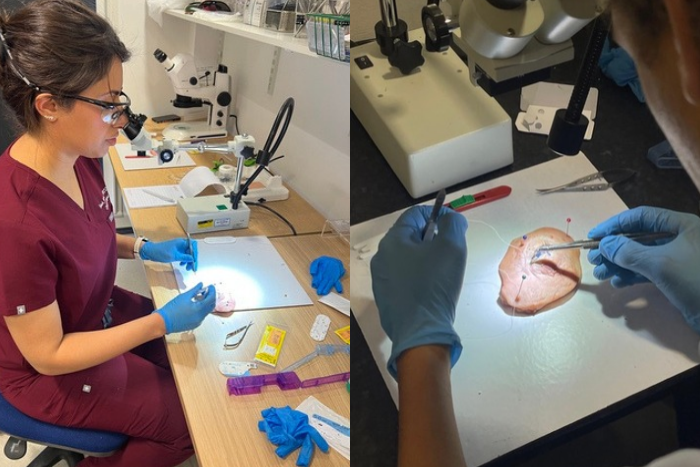
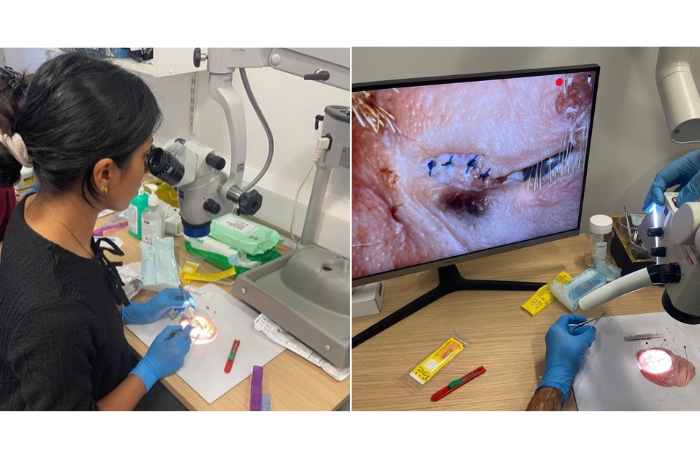
Some examples of the wet lab are shown below.
Who is this course for?
Ophthalmology resident doctors from ST1 and above and oculoplastic fellows new to the UK, and specialty doctors working in adnexal clinics.
Course leaders
- Mr Jameel Mushtaq, Ophthalmology trainee, Moorfields Eye Hospital.
- Mr Robert Brady, Adnexal fellow, Moorfields Eye Hospital.
- Miss Swan Kang, Adnexal consultant, Moorfields Eye Hospital.
CPD accreditation
A certificate of attendance will be awarded at the end of the study day. CPD points will be awarded.
Course date
The course is due to take place on 23 April 2027, in-person at The Education Hub, 15 Ebenezer Street, London, N1 7NH. Register your interest by joining our waiting list and we'll let you know when bookings open.